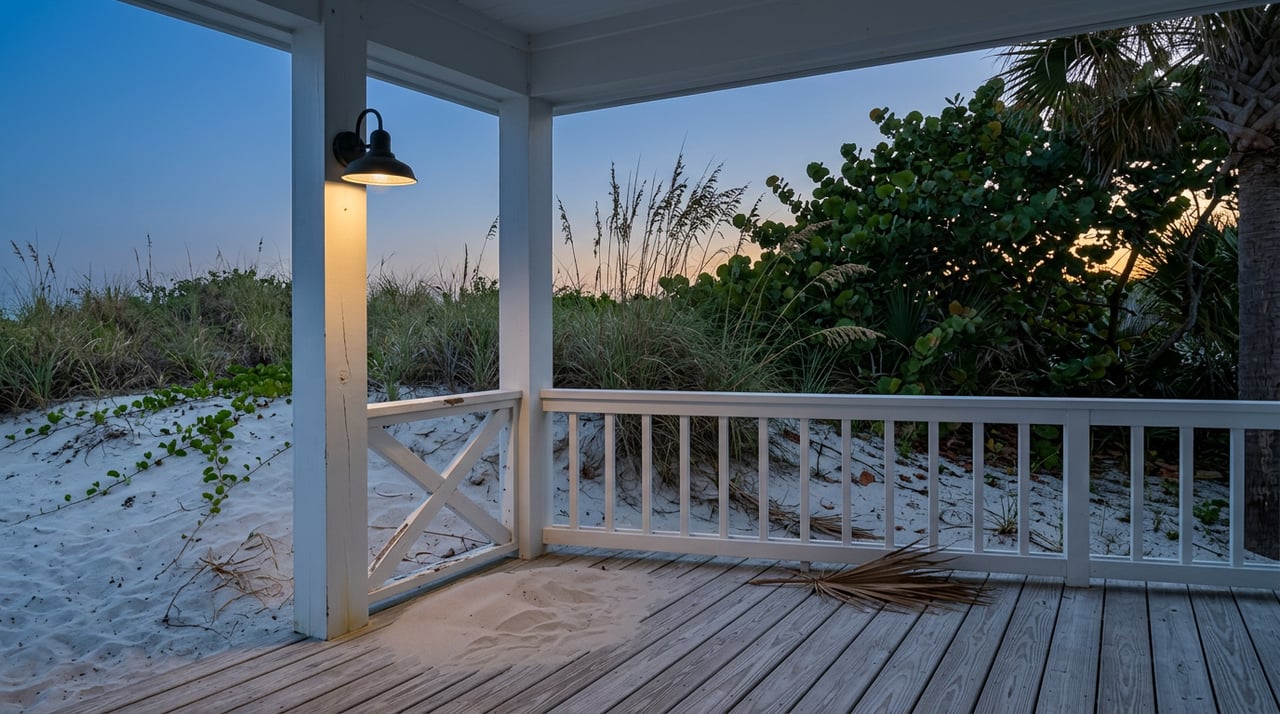
Walk the beach at Blowing Rocks Preserve on a June morning and you'll dodge orange stakes and roped-off squares of sand every few hundred feet, each one marking a nest a loggerhead or green turtle dug the night before. Walk the same stretch in late August and the stakes are still there, but something else has started happening underneath them. The eggs laid in May and June are hatching now, and they'll keep hatching into October.
Most people who live here think of turtle season as the springtime part: the nesting females hauling themselves up the beach at night, the volunteer walks, the photos of flipper tracks in the sand. That's half the season. The second half, the one running right now through the end of October, is quieter, less photographed, and arguably more consequential for anyone who owns a light switch within sight of the water.
The Season Everyone Pictures Isn't the Season Happening Now
Palm Beach County's official sea turtle nesting season runs from March 1 through October 31, with peak nesting concentrated in May, June, and July. Eggs take about 60 days to incubate, so a nest dug at the height of that peak doesn't produce hatchlings until well into August or September. That two-month lag means the visible, romantic part of the season (a turtle emerging from the surf) and the vulnerable, statistically riskier part (dozens of two-inch hatchlings trying to find the ocean in the dark) happen on almost opposite ends of the calendar.
The guided turtle walks that ran on Thursday and Friday evenings through June and July, meeting at the Hobe Sound public beach off Jupiter Island Beach Road and A1A, have already wrapped for the year. That doesn't mean the beach goes quiet. It means the activity moves from an evening spectacle organized around reservations to an early-morning one, unscheduled, and mostly invisible unless you're already out there.
Why This Particular Stretch of Sand
Blowing Rocks Preserve sits on 73 acres of Jupiter Island, donated by island residents in 1969 and managed since by The Nature Conservancy. In a busy year, its one-mile stretch of shoreline hosts more than 1,000 sea turtle nests from four different species: loggerhead, green, leatherback, and hawksbill. Preserve staff have been direct about why turtles keep choosing this particular mile of coast over the built-up beaches around it. The beach stays dark at night, unlike the surrounding development, and that darkness is the single biggest reason nesting females keep coming back.
You can see the same pattern a few miles south, where the numbers get even more extreme. The town of Jupiter Inlet Colony, which calls itself the densest sea turtle nesting habitat in Palm Beach County, recorded 2,558 nests on just 0.9 miles of beach during the 2025 season. Do the arithmetic and that's roughly 2,840 nests for every mile of sand, well above what even Blowing Rocks logs in a strong year. Both places benefit from the same dark-beach effect. The degree of it just varies house to house and town to town, depending on how much light actually reaches the sand.
That's the mechanism worth holding onto: turtle density along this corridor isn't random luck. It tracks, almost block by block, how dark the beach stays after sunset.
2026 Has Been an Unusual Year, and the Corridor Is Still Adding to It
This isn't a typical season to be watching hatch out. Statewide, loggerhead nests reached 94,667 by June 30, the highest total recorded by that point in the past five years, and leatherback nests hit 2,152 by the same date, on pace for a new statewide record. Forty miles south in Boca Raton, a beach monitored separately but shaped by the same regional surge, biologists confirmed 1,077 loggerhead nests this season, breaking a record that had stood since 1990, and a new leatherback record of 43 nests, well past the previous mark of 33 set in 2012.
Jupiter Island's own final count for 2026 isn't in yet. But the corridor it sits in has already broken records that predate most of the homes currently standing on this stretch of coast. Whatever number Blowing Rocks and its neighbors post this year, there's more incubating in the sand right now than in a typical season, and a larger share of it than usual is hatching out this fall.
The Number That Complicates the Good News
More nests doesn't automatically mean proportionally more turtles reaching the water. Boca Raton's conservation team has tracked hatch success (the share of eggs in a nest that actually produce a hatchling that makes it out) at around 65 percent, and that figure has been trending downward over recent years. Part of the reason is warming sand temperatures, which are pushing more nests toward producing almost entirely female hatchlings, since sea turtle sex is determined by nest temperature rather than genetics.
That downward trend is a reminder that record nest counts and record hatchling survival are two different statistics, and only one of them is something a resident of this island can influence day to day. The other one, the one within reach, comes down to how dark the beach stays at night between now and Halloween.
What Changes for Anyone With a Porch Light
Homes along the Palm Beach County end of this stretch, near where Blowing Rocks Preserve meets the shoreline protection boundary, fall under the county's Unified Land Development Code Article 14.A, the Sea Turtle Protection and Sand Preservation Ordinance. It requires a permit from Palm Beach County Environmental Resource Management before any exterior light fixture facing the beach is installed or replaced, and that requirement applies to residential properties, not just hotels and commercial buildings.
Practically, for the next two months, that means a short list most people already half-know but rarely follow through October:
- Shield or turn off any light visible from the beach after dark, including porch lights, pool lights, and landscape uplighting
- Close blinds or curtains on beach-facing windows at night rather than relying on the glass alone to block the glow
- Bring in chairs, umbrellas, and toys before dark so hatchlings don't get trapped trying to crawl around them
- Skip the flashlight and the phone flashlight on a night beach walk. Both can disorient a hatchling heading for what it thinks is the horizon
- Fill in any holes dug below the high-tide line so a nest or a crawling hatchling doesn't get stuck
Anyone on the water has a version of the same ask. Loggerhead Marinelife Center maintains a voluntary Sea Turtle Protection Zone that extends one mile offshore across the entire 45-mile Palm Beach County coastline from March 1 through October 31, and it specifically asks boaters moving through Jupiter Inlet, the main channel this stretch of coast uses to reach open water, to slow down and watch for turtles resting near the surface.
Where the Preserve Still Welcomes a Visit
None of this means the beach is off limits. Blowing Rocks Preserve stays open seven days a week from 9 a.m. to 4:30 p.m., and the Hawley Education Center runs its own guided nature walks most Saturdays at 10 a.m., covering the preserve's habitats generally rather than turtle nesting specifically now that the reserved evening walks have ended for the season. Early morning is genuinely the better time to be out there anyway. That's when Nature Conservancy staff and volunteers patrol the beach looking for hatchlings or nesting females that have gotten wedged in the preserve's limestone crevices, the same craggy Anastasia rock formations that give Blowing Rocks its name and its waves.
The season most residents picture when they hear "turtle season" wrapped up in July. The one actually unfolding on this beach right now, in a year that's already broken records up and down this coast, runs another two months. What happens to it from here has less to do with the turtles and more to do with what everyone on this stretch of sand does with their lights after dark.
If you're weighing what living on this part of the coast actually looks like month to month, not just in high season but through the quieter stretches like this one, that kind of on-the-ground detail is exactly what Trisha Hutchinson spends her time tracking across Jupiter Island and the surrounding barrier island communities. Reach out anytime you want a local read on a neighborhood before you make a decision about it.